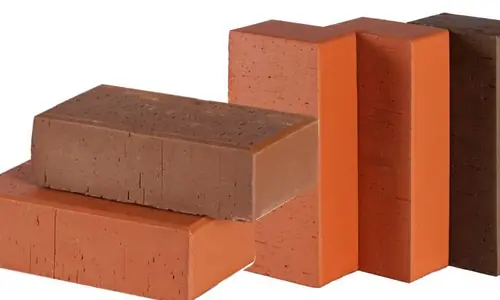
Solid brick has no more than 13% voids and is used for laying foundations, plinths, and load-bearing walls. This is a classic building material that can bear heavy loads.
Moreover, due to such material structure it poorly absorbs moisture, which explains its high resistance to aggressive atmospheric influences and high frost resistance. However, this type of brick poorly retains heat, therefore it is always additionally faced with hollow brick or an insulation layer, for example, mineral wool. Its production consumes more material, so its cost is higher than that of hollow brick. Residential complex Victory is built exactly from this type of brick.
Hollow brick is characterized by the presence of voids from 30 to 50% of the total material amount.

The voids have various shapes – round, oval, square, as well as through and non-through. The latter are more popular among builders. Hollow brick excellently retains heat, provides good sound insulation, but does not cope with high loads. Therefore it is used for laying interior partitions, facade facings, or filling voids in houses with a monolithic frame.
Such walls are built in Otrada Sky on Vice-Admiral Azarova Street, 8.
More objective characteristic is density of brick. Density means what load 1 m3 of brick can accept. Solid brick has density from 1600 to 1900 kg/m3, while hollow brick – from 100 to 1430 kg/m3. Exactly density determines the brick grade and is denoted by the letter M in marking. The higher the digit after the letter M, the higher the density of this material. In total there are 7 grades of red ceramic brick – M75, M100, M125, M150, M200, M250 and M300.
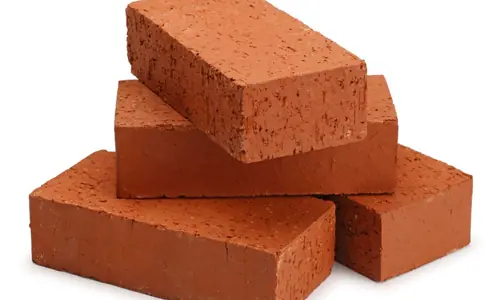
Bricks of grades M75-M125 are the most demanded budget options of this material and are excellent for constructing low-rise buildings and their facing. Solid bricks of grade M150 are already used for laying foundations, basement floors, load-bearing and outer walls of multi-storey houses. Bricks of grades M200 and M250 have good water resistance and withstand high loads, while M300 is the most reliable option for foundations and basement premises of multi-storey houses.
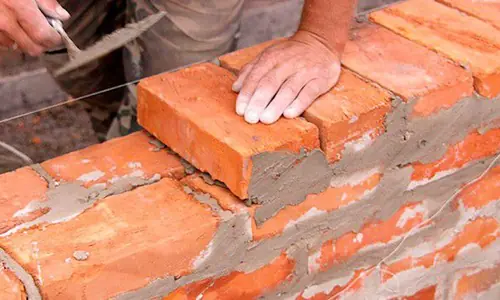
For homeowners the most important characteristic of ceramic brick is its energy efficiency. It is measured by the thermal conductivity coefficient and shows how much thermal energy must be spent to raise the temperature by 1°C in a room with wall thickness of 1 m. The lower this indicator, the better the thermal insulation properties of a particular brick type.
For solid bricks it is 0.6-0.7 W*m*°C, and for hollow bricks – 0.25 - 0.5 W*m*°C.