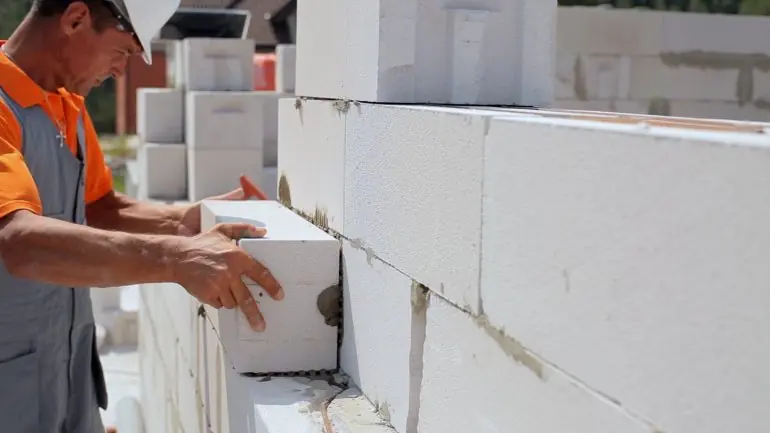
Aerated concrete is not all the same. One of the main characteristics of aerated concrete is its
density (or grade) – i.e., the percentage content of air and concrete mixture.
Based on density, aerated concrete is conventionally divided into three groups:
- Insulators – density 150-250 kg/m3. Used only as a second layer or insulation.
- Enclosing – density 300-500 kg/m3. Partitions and external non-load-bearing walls.
- Load-bearing walls – density from 600 kg/m3.
In
new buildings in Odesa, if aerated concrete is used, it is most often as infill walls in a monolithic-frame house structure. Therefore, developers usually choose aerated concrete of medium density.
According to DBN V.2.6-31:2006
«Thermal insulation of buildings», the territory of Ukraine is divided into two temperature zones. Odesa belongs to the second temperature zone, and accordingly the minimum thermal resistance of walls should be 2.8 m2·K/W. Knowing the values of the thermal conductivity coefficient of aerated concrete blocks, one can calculate the minimum normative wall thickness for various aerated concrete grades. It is mandatory to consider that the moisture content of aerated concrete blocks in already constructed buildings is 4–8%, which negatively affects the thermal conductivity coefficient.
To better understand the above-described technical characteristics, let's look at the table below:
| Aerated concrete grade |
k1 (W/m·K) |
k2 (W/m·K) |
p min cm. |
| Aerated concrete D300 |
0,08 |
0,096 |
26,88 |
| Aerated concrete D400 |
0,1 |
0,12 |
33,6 |
| Aerated concrete D500 |
0,12 |
0,144 |
40,32 |
| Aerated concrete D600 |
0,14 |
0,168 |
47,04 |
k1 -
thermal conductivity coefficient at 0% moisture of aerated blocks
k2 -
thermal conductivity coefficient at 10% moisture of aerated blocks
p min - minimum wall thickness required to meet the thermal resistance standards for the Odesa region. R = 2.8. At 10% moisture of aerated blocks.
What does all this mean?
When using aerated concrete blocks of grade D300, a wall thickness of 30 cm is sufficient, and even less when accounting for plaster and interior finishes.
However, with the constant rise in energy resource costs and utility tariffs, heat retention issues are becoming increasingly relevant. Therefore, construction companies increase wall thermal resistance by using various insulation materials.
What materials can be used to insulate aerated concrete, and which are absolutely prohibited? You will learn this in our next article
"Proper insulation for aerated concrete".
In conclusion, we want to say that we help you make the right choice in the process of
purchasing an apartment in new buildings in Odesa, we assess investment risks in construction projects. We are partners in sales with practically all reliable construction companies in Odesa; our services for you are completely free, and apartment prices and sales conditions remain the same.
We will be happy to hear from you. Our phone numbers are
048 700